 (587) 703-6048

Concrete Pumping for Shop Floors That Finish Right

A shop floor is not just another slab. It carries vehicles, equipment, shelving, livestock traffic, fabrication work, and years of freeze-thaw grime dragged in from an Alberta yard. Concrete pumping for shop floors gives the placing crew the control to keep concrete moving steadily from truck to slab, without turning the pour into a wheelbarrow relay.
For a detached garage, farm shop, commercial bay, or industrial workspace, the pump choice and pour plan affect more than speed. They affect crew fatigue, concrete consistency, finishing time, joint layout, cleanup, and the final flatness of the floor. Get placement right, and the finishing crew can focus on the slab instead of fighting a pile of concrete dumped in the wrong place.
Why Concrete Pumping for Shop Floors Makes Sense
Shop-floor pours often look straightforward on paper: a prepared base, forms, reinforcement, concrete trucks, and finishers. The problem is that access is rarely as simple as it appears. A building shell may already be up. The slab may sit behind a tight driveway, around existing structures, or beyond the practical reach of a ready-mix chute.
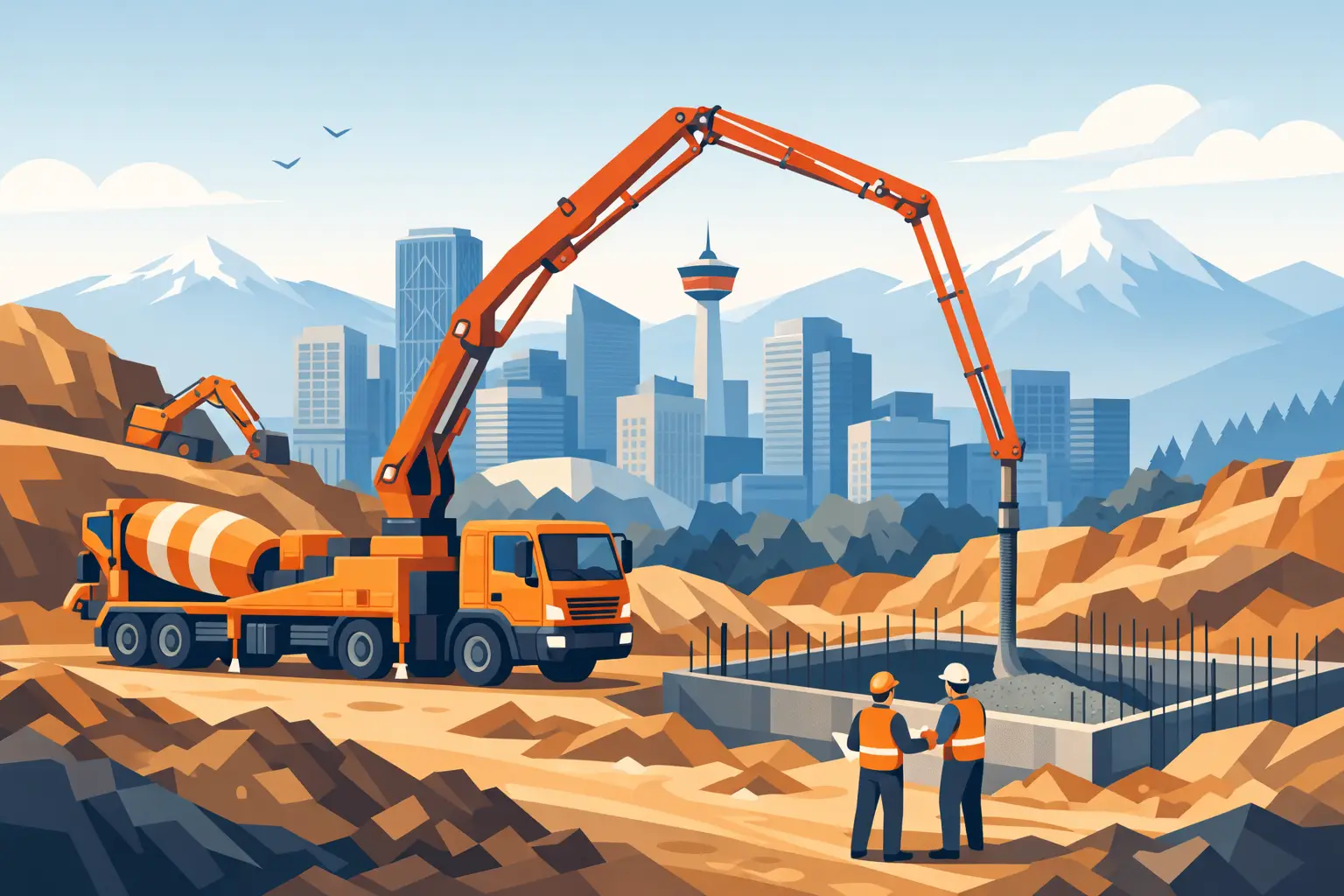
A concrete pump brings the material to the point of placement. With a boom pump, the operator can reach across a building footprint or over an obstruction while keeping the ready-mix truck in a workable position. A truck-mounted line pump is often the better fit where access is restricted and the hose needs to run through, around, or beyond the building.
That reduces unnecessary handling. Instead of moving concrete repeatedly by skid steer, buggy, or wheelbarrow, the crew places it close to final grade and spreads it with rakes. Less handling means less chance of segregation, fewer delays between loads, and a more manageable pace for screeding and finishing.
A pump does not replace a capable flatwork crew. It gives that crew a better starting point. The quality of the finished slab still depends on proper base preparation, reinforcement, mix design, joint planning, weather management, and finishing practice. But controlled placement removes one of the biggest avoidable bottlenecks.
Steady placement protects the finishing window
Concrete has a working window. On a warm, dry Alberta afternoon, that window can close faster than expected. Wind, sun, low humidity, and a long distance from truck to slab all make timing more difficult. If concrete arrives in uneven piles or the crew falls behind moving it, one area may start setting while another is still being placed.
Pumping helps maintain a consistent flow. The operator works with the concrete contractor and ready-mix drivers to place manageable sections in the planned sequence. This allows the screed crew to stay ahead, keeps finishers working in an orderly pattern, and reduces the temptation to add water to a slab that is becoming difficult to work.
For larger shop floors, pour sequencing matters. The crew may work from the far end back toward the access point, place in strips, or follow a layout designed around construction joints and laser screed operations. There is no single approach for every slab. The right plan depends on the building dimensions, thickness, access, crew size, concrete supply, and finish specification.
Planning the Pump Setup Before Concrete Arrives
The pump truck needs a safe, stable place to set up. This is not a detail to sort out when the first ready-mix truck is already at the gate. The operator needs enough room for outriggers, a firm setup area, a clear path for concrete trucks, and overhead clearance from power lines, trees, roof edges, and structures.
For a boom pump, reach is only one part of the equation. The boom must be positioned so the hose can cover the pour efficiently without excessive repositioning. A compact roll-and-fold boom can be a practical choice on constrained urban or residential sites, while a larger boom provides broad coverage for bigger commercial and industrial footprints.
A line pump can be the practical answer when a boom cannot safely access the slab. It can move concrete through pipeline and hose to difficult locations, making it useful for enclosed shop sites, rear-yard structures, tight acreage layouts, or projects where the building is already framed and roofed. The trade-off is that line placement requires a clear hose route, more setup planning, and attention to protecting finished surfaces or sensitive areas along that route.
Before booking, the contractor should have the key details ready: slab size and thickness, estimated concrete volume, mix specification, reinforcement, site access, truck route, overhead hazards, pour date, and expected start time. Photos of the site and a simple plan can prevent surprises. If the pump operator can see the access constraints early, the right equipment can be assigned before the schedule is locked in.
Set the crew around the pump, not against it
A pump works best when everyone understands their role. The pump operator controls the equipment and places concrete where directed. The placing crew manages the hose, spreads material, and keeps the work area organized. Screed operators establish grade. Finishers follow behind at the pace the slab allows.
Clear communication is essential. One designated person should direct hose placement so the operator is not receiving conflicting signals from several people. The crew should also establish where ready-mix trucks enter, stage, wash out, and exit. A disorganized truck rotation can stop a well-planned pour just as quickly as poor access.
Keeping the hose close to the slab helps avoid dropping concrete from unnecessary height. Lower placement reduces splashing, keeps reinforcement from being disturbed, and makes it easier to distribute material evenly. The objective is not to blast concrete across the floor. It is to place it accurately, in a controlled pattern, with enough material for the crew to strike off efficiently.
The Details That Affect a Durable Shop Slab
Concrete pumping is part of the placement plan, not the entire slab design. A shop floor must be built for its intended use. A floor supporting light personal vehicles has different requirements than one carrying loaded farm machinery, forklifts, racking, or heavy fabrication equipment.
Thickness, base preparation, reinforcement, compressive strength, air content, and joint spacing should be decided by the contractor and, where required, the project engineer. If the slab will see vehicle traffic, de-icing salts, welding work, oil exposure, or hard-wheeled equipment, the finish and curing plan deserve the same attention as the pour itself.
Flatness expectations also need to be realistic and specific. A general-purpose shop slab may not require the same tolerances as a warehouse designed for narrow-aisle forklifts. At the same time, a floor with visible puddling, abrupt joint edges, or inconsistent grade can create problems long after the crew has left. Discuss the intended use before the pour so the finishing method matches the job.
Curing is where many good pours lose ground. Concrete needs protection from rapid moisture loss, cold conditions, and early traffic. In Central Alberta, weather can change quickly, even during a single pour. Windbreaks, curing compound, blankets, heaters, or temporary enclosures may be needed depending on the season and forecast. Pumping gets concrete in place efficiently, but it does not remove the need for disciplined curing after the finishers are done.
When Pumping May Not Be the Best Option
For a very small slab with open access, a ready-mix chute may be enough. If the truck can safely reach the forms and the crew can place the concrete without delays or excessive labour, pumping may not add value. The same applies when the site cannot provide a safe setup area or access for the pump truck.
But many shop-floor pours are larger than they first appear, especially once a thickened edge, apron, equipment pad, or interior grade beam is included. Labour adds up quickly when concrete has to travel a long way from the truck. Delays also cost money when finishers are waiting, ready-mix trucks are stacking up, or the pour extends into poor weather or fading light.
The best decision comes down to site conditions, scope, crew capacity, and timing. A pump should solve a real placement problem, not simply be added out of habit.
Bandit Concrete Pumping helps contractors and property owners match the pump setup to the job, from broad-reach boom placement to line pumping in restricted locations. A clean, well-planned setup keeps the concrete moving and gives the flatwork crew the room to do what they do best.
For your next shop floor, plan the concrete route as carefully as the slab itself. A prepared base and a good mix matter, but accurate placement is what gives the whole crew a fair chance to finish the floor properly.