 (587) 703-6048
Concrete Pumping for Patios That Stays on Track

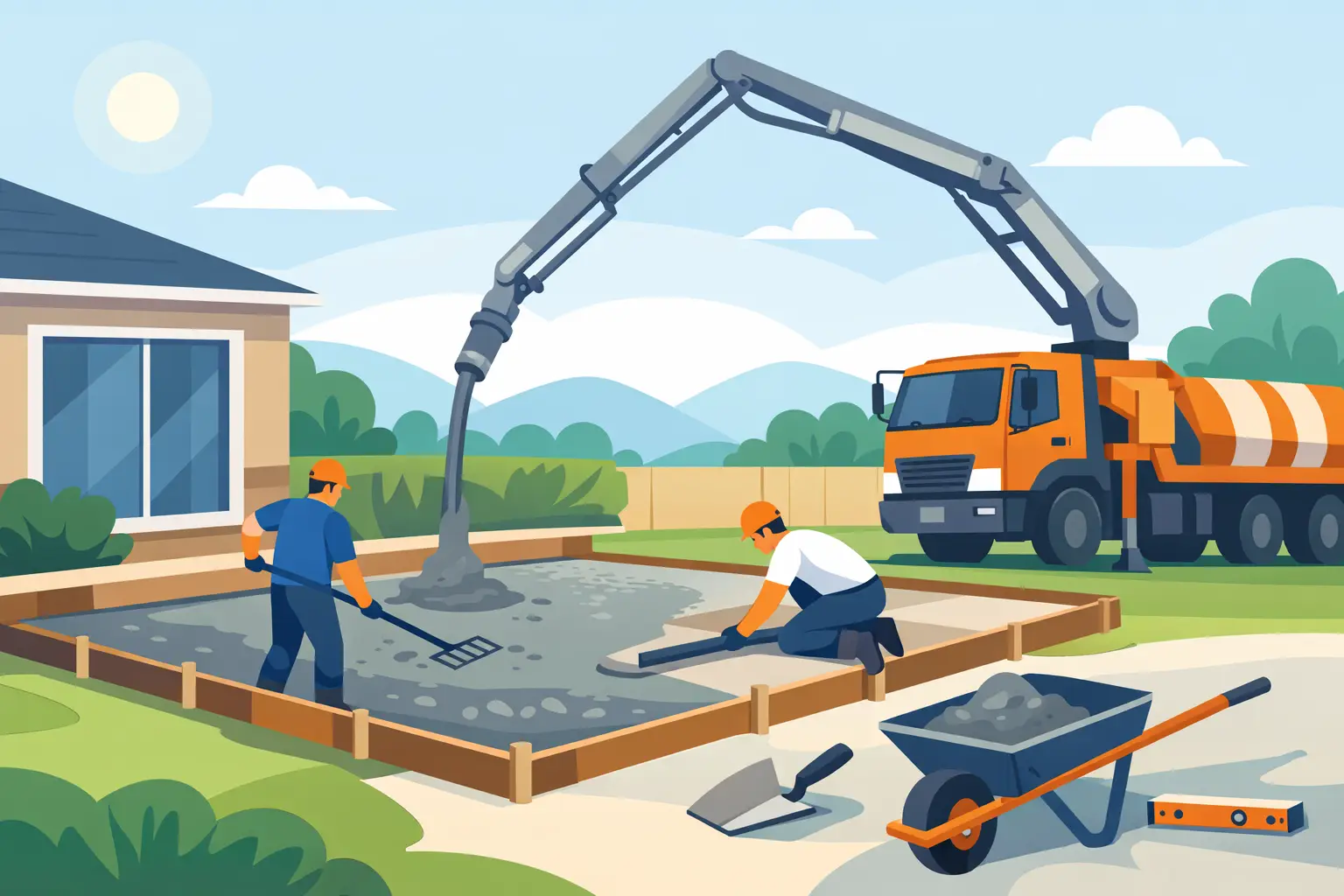
A patio pour can look simple on the drawings: a formed rectangle behind the house, a few cubic metres of concrete, and a finishing crew ready to go. On site, it is often a different story. Fences, landscaped yards, narrow side access, soft ground, stairs, and finished exterior surfaces can turn chute or wheelbarrow placement into a slow, labour-heavy job. Concrete pumping for patios gets the concrete from the truck to the forms quickly and accurately, without turning the whole yard into a haul route.
For contractors and property owners across Central Alberta, the benefit is not just speed. A properly planned pump pour gives the finishing crew a steadier supply of concrete, reduces unnecessary handling, and helps protect the work area around the patio. The right pump and operator can make a difficult backyard placement feel like a controlled pour instead of a race against the clock.
Why patio pours create placement problems
Most patios sit where access is limited: behind an existing home, between property lines, beside a garage, or beyond established landscaping. Ready-mix trucks need firm ground and room to manoeuvre. Their chutes have limited reach, which means they cannot always discharge directly into the forms.
Wheelbarrows can bridge that gap, but they add people, time, and risk. Each load has to be moved, dumped, and spread before the next arrives. On a larger patio, that can leave finishers waiting in one area while concrete is still being hauled to another. It also creates more opportunities to track concrete onto walks, driveways, sod, and siding.
Pumping puts the placement point where the crew needs it. The hose can be moved around forms, corners, steps, and thickened edges with far less manual travel. That matters when placing a patio with grade beams, integrated stairs, a hot-tub pad, retaining-wall connections, or a wider slab that needs consistent progress from one end to the other.
When concrete pumping for patios makes sense
A pump is not required for every patio. If the truck can back close to the forms, chute access covers the pour, and the volume is modest, direct discharge may be the practical choice. The job changes when access, distance, or finishing requirements start working against the crew.
Concrete pumping for patios is usually a strong fit when the forms are behind a house, access is restricted by fences or buildings, the pour is too far from the truck for a chute, or the route to the forms crosses landscaping and finished surfaces. It also makes sense when a small crew needs to place a larger volume efficiently, rather than assigning several workers to wheelbarrow duty.
The cost should be considered against the whole operation, not just the pump ticket. Fewer labour hours, faster placement, less site cleanup, and reduced risk of damage can make pumping the better value. On a tight schedule, avoiding a slow placement day can also protect the next trades and prevent a patio project from dragging into another weather window.
Choose the pump around the site, not the slab size
The patio volume matters, but access is usually the deciding factor. A boom pump is often the right tool when the truck can set up on the street, driveway, alley, or an open area and reach over obstacles to the backyard. Its boom gives broad coverage, allowing the operator to place concrete throughout the forms without repeatedly relocating the truck.
For restricted residential sites, compact roll-and-fold boom equipment can be especially useful. It can provide the reach needed for a backyard while working around lower overhead clearances and tighter setup conditions. The operator still needs sufficient room for safe outrigger placement and boom movement, so site details should be discussed before pour day.
A truck-mounted line pump is often the better answer when a boom cannot safely reach the work, when overhead obstructions limit boom use, or when concrete must travel through a narrow route to a precise placement area. Line pumps are well suited to difficult-to-reach patios, enclosed yards, and work where hose routing offers more control than overhead placement.
There is no universal best option. A 12-by-14-foot patio beside open access has very different needs than a large exposed-aggregate patio behind a finished infill home. Sharing photos, dimensions, truck access information, and the planned form layout ahead of time helps the pumping company select equipment that fits the actual site.
Plan the site before the truck arrives
A clean patio pour starts before concrete is ordered. The forms should be complete, braced, and checked for line and elevation. Base preparation, reinforcement, dowels, thickened edges, drains, and sleeves should be ready before the pump sets up. Once concrete is flowing, the crew should be placing and finishing, not searching for missing stakes or correcting loose forms.
Truck access needs the same attention. Identify where the pump truck and ready-mix trucks will park, enter, exit, and turn around. Confirm overhead hazards such as power lines, service wires, trees, rooflines, and temporary structures. Check ground conditions, particularly after rain or spring thaw. A pump truck needs a stable setup area, and ready-mix trucks need a route that will not leave them stuck or damage the property.
The hose path also deserves a walk-through. Protect areas where hose may cross finished concrete, paving stones, lawn, garden beds, decks, or exterior corners. Clear gates and remove movable obstacles. If the hose must pass through a side yard, make sure the width, turns, and gate openings are known in advance.
For occupied homes, communication matters. Let homeowners know where trucks will be positioned, how long the work is expected to take, and which areas need to remain clear. A good plan avoids avoidable surprises, especially on narrow streets or shared driveways.
Match the mix and crew to pump placement
Not every concrete mix behaves the same way through a pump line. The concrete supplier, placing contractor, and pump operator should be aligned on the mix design, aggregate size, slump requirements, fibres, air content, and any admixtures. A pumpable mix does not mean a watery mix. Adding excess water on site can affect strength, finish quality, shrinkage, and durability.
This is especially relevant for patios exposed to Alberta freeze-thaw cycles. Air entrainment, proper finishing, joints, drainage, and curing all influence how the slab performs through winter. Pumping improves placement, but it does not replace sound concrete practice.
The finishing crew should be sized for the pour and ready when the first load arrives. One person should guide placement with the hose, while others strike off, bull float, edge, and manage joints as required. The goal is to keep concrete moving steadily through the forms without overworking it or allowing one section to get too far ahead of another.
If the patio includes decorative finishes such as exposed aggregate, stamped concrete, or coloured concrete, coordination becomes even more important. Those finishes have timing requirements. A steady pump pour gives the crew better control, but only if materials, tools, wash-out plans, and labour are all in place.
What a well-run patio pump pour looks like
On pour day, the operator sets up the equipment safely and confirms the placement plan with the crew. The hose is positioned at the starting point, and concrete is placed in a sequence that allows the crew to spread and consolidate it efficiently. Rather than piling concrete high in one location and dragging it across the slab, the hose is moved to distribute material closer to its final position.
That controlled placement reduces the effort required to strike off the slab and helps maintain consistent depth. It is particularly useful along edges, around stairs, and beside house walls where accuracy matters. The operator and finishing crew work as one team: the crew signals where material is needed, and the operator keeps the delivery controlled.
Cleanup should be part of the plan, not an afterthought. Concrete residue can damage landscaping and leave hard-to-remove marks on finished surfaces. Clear wash-out arrangements, protected travel areas, and an experienced pumping crew help keep the site orderly. Bandit Concrete Pumping focuses on placing concrete accurately while keeping the job moving and the work area as clean as practical.
The details that protect the finished patio
Pumping gets concrete into place, but the patio’s long-term performance is decided by details that follow. The slab needs correct slope away from the building, appropriately located control joints, proper edge treatment, and curing that suits the weather. Hot, dry wind can pull moisture from a fresh slab quickly. Cool conditions can slow set times and change the finishing schedule.
Do not rush the first days after placement. Follow the concrete contractor’s curing and protection recommendations, keep traffic off the slab until it has gained adequate strength, and avoid applying de-icing salts during the first winter. Where de-icing is needed later, use products suitable for concrete and avoid aggressive chemicals that can contribute to surface damage.
A patio is often the last major piece of a backyard build, which is exactly why placement needs to be planned carefully. Get the pump, concrete supply, forms, finishers, and access plan lined up before the trucks roll. Then the crew can spend the day building a patio that looks right, drains right, and is ready for the years of use ahead.